12th November 2010


v37


Michael Thonet was born on 2 July 1796 in Bopard-am-Rhein, Prussia (present day Germany). Quite fittingly he started life near the start of the industrial revolution. He would go on to form a company and pioneer mass production, both attributes of this new industrial era. He trained as an apprentice cabinet maker in his home town. After his apprenticeship, he began almost immediately to experiment with bentwood and veneers in furniture. In 1842, Thonet was invited to Vienna by the Chancellor of Austria to do some of the furniture for the Palais Liechtenstein. His work was still very experimental at this point but displayed an innovative spirit which attracted the Chancellor. Despite being invited to become the official furniture designer to the throne of Austria, Thonet chose to remain independent. He had set his sights on a larger audience.
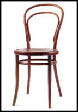
Thonet set up his own company in the furniture trade, Gebr der Thonet, with his five sons and apprentices in the furniture trade in 1853. By 1856, he had perfected his technique and prepared for mass production through opening his own factory in Vienna. He designed the factory himself. Success quickly followed, so much so that Thonet soon had to open another factory. This time the factory was located at Koritschan, in the modern day Czech Republic. This factory was situated close to a large beechwood forest, as well as a supply of cheap labour. Thonet had streamlined his process even more by this time, reducing production costs all the way through his process. The beechwood forest eliminated the need for costly wood importation. Although Michael Thonet died in 1871, his designs and production process lived on however, with his sons. By 1913, Gebr der Thonet employed 6,400 workers and produced 1.8 million pieces of furniture a year. One chair, the No.14 chair alone sold 40 million copies between 1859 and 1939.
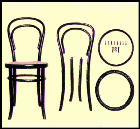
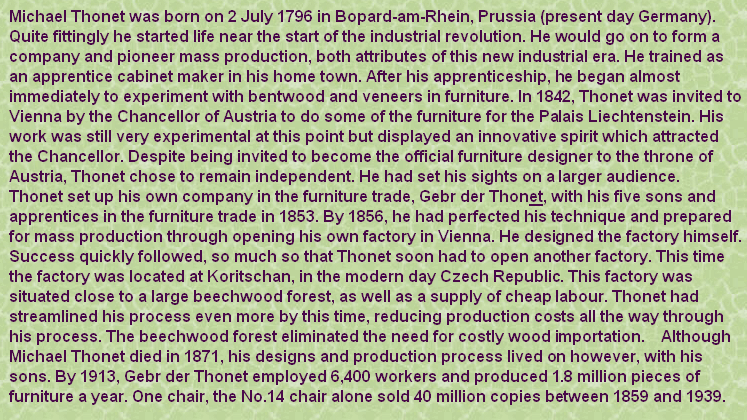
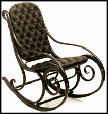
gradually introduced his process of steam shaping. As there were no other carftsmen producinhg this sort of furniture Thonet was in the same position as those designers of modern times who experiment with composites, polymers, smart materials and alloys in creating products that satisfy identified markets. After working for others for several years making wooden parquet flooring and chairs for the Palace at Lichtenstein, Thonet set up production of one of his chair designs. More than simply designing the product Thonet realised he would need to produce the chairs in large numbers and to do this he set up factories to manufacture them. Between 1859 and 1893 more than 15 million chairs of 'THONET'S No.14" design were made. He had exhibited at the Crystal palace exhibition in London as well as at Paris and had an international reputation. One of the main advantages of his chair design being that it could be shipped disassembed and - much in the manner of many modern products - reassembled at the point of use. At its peek - in the mid 1870s - the factory owned by Thonet produced 2000 units a day and employed over 4000 workers. A useful example of early mass manufacturing in action. During your own studies you may most liklely have predominantly been considering the appearance of products and you might have considered how well the item works - but it should not be forgotten that products have to be manufactured. The factory producing the item must do the assembly quickly and efficiently and it
is the designers responsibility to see that this is possible - by understanding processes and materials. Following Thonet’s patent expiring many copies and variants were designed and made.
Michael Thonet (born: 1796 d. 1871 ) was a pioneer in the designing of shaped wooden furniture and developed a steaming process for softening and allowing the bending of beechwood. In the early 1800s he had undergone training as a joiner and started making cabinets at his workshop in Boppard - on the Rhine, in Germany. He started by laminating wood and veneers and



1860

1880
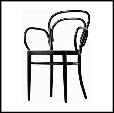
1859
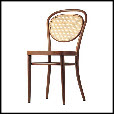
THONET'S No.215
THONET'S No.14
1859
THONET'S No.214
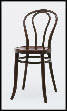
No.18

~ Design & Technology ~
Designers and Designing
Designers and Designing
