





14th November 2010





Calculating TOTAL RESISTANCE in ELECTRIC CIRCUITS
Obviously as you go around the circuit the potential difference will drop to zero since one side of the power source is positive and the other negative.
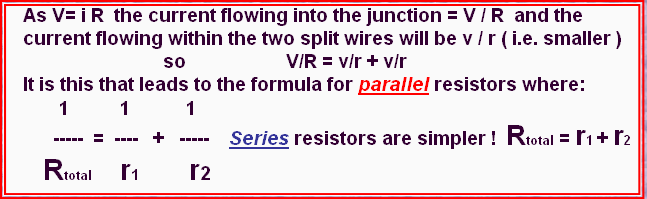
If resistance are joined in parallel then values cannot be simply added together - values need to be treated differently.
KIRCHOFF'S LAWS state two things.…
Hopefully looking at this simple diagram may convince you that this is logical
Any physical limitation in numbers of atoms capable of passing on charge
will limit current flow.
V = iR where i is the current, V is
will limit current flow.
V = iR where i is the current, V is
the voltage (potential difference) and R the resistance in the circuit.




2) At the junction of two or more wires the current flowing into the junction is equal to the current flowing out of the junction.
So V start + ( Drop1) + (Drop 2) = 0 since both 'drops' are negative
1) That the sum of potential differences in a circuit add up to zero voltage




IWB Electronics Wordsearch
Download Wordsearch
